Best Things to Do:
- 1. May 8: what is the reason for this holiday in France?
- 2. What is the reason for the May 8 holiday?
- 3. The ups and downs of the May 8 holiday in France
- 4. The festivities
- 5. Where to commemorate May 8 in Paris
- 6. Musée de l'Armée/Invalides
- 7. Memorial to General Leclerc and the Liberation of Paris
- 8. Jean Moulin Museum
- 9. Shoah Memorial (Holocaust Memorial)
- 10. Fort Mont-Valérien
- 11. May 8 in the streets of Paris
- 12. Commemorative plaques
May 8: what is the reason for this holiday in France?
What is the reason for the May 8 holiday?
Many ask us what the reason for the May 8 holiday in France is. Do you know? If not, read our article.
On May 8, we celebrate the victory of the Allied Powers over Nazi Germany and the end of World War II in Europe, marked by the announcement of the German surrender.
The ups and downs of the May 8 holiday in France
The law of May 7, 1946, stipulated that the commemoration of "May 8, 1945" would be held on May 8 of each year - if that day fell on a Sunday - or on the following Sunday if May 8 fell on a weekday.
Over the years, the commemoration has lost its significance, while veterans' associations - which organize their own commemorative events - demand recognition of May 8 as a paid national holiday.
The 1953 law declares May 8 a public holiday of commemoration in France. The ceremonies gained true splendor from 1953 to 1958.
In 1959, in the spirit of reconciliation with Germany, President Charles de Gaulle removed the holiday from this day and fixed the commemoration date to the second Sunday in May. In 1968, it was decided that May 8 would be celebrated every year, on its own date, at the end of the day.
In 1975, still under the spirit of peace and cooperation among all European countries, President Giscard d'Estaing abolished the commemoration of May 8 (the Allied victory of 1945). This decision sparked widespread protests from French veterans' associations.
It was at the request of President François Mitterrand that this commemoration and holiday were restored in 1981.
On this day, commerce, restaurants, museums, and monuments operate normally. Only the Arc de Triomphe remains closed in the morning.
The festivities
At 10:30 AM on May 8, the President of the Republic lays a wreath at the foot of the statue of General Charles de Gaulle, located at Place Clémenceau, at the corner of the Champs-Élysées. He then continues along the Champs-Élysées to Place de l'Etoile - where the Arc de Triomphe is located - and inspects the troops.
The celebration ceremony concludes with a tribute to the soldiers who died in the war. Wearing the blueberry of France on his lapel, the President lays a wreath in front of the Tomb of the Unknown Soldier, located under the Arc de Triomphe. "Le Chant des Partisans" is performed by the French army choir, and then the President signs the visitor book of the Flame of Remembrance before greeting the veterans and officers of the General Staff.
Where to commemorate May 8 in Paris
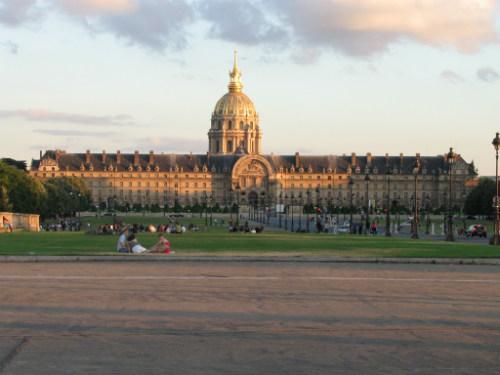
To celebrate May 8 thematically in grand style, here is a list of the main museums, memorials, and sites related to World War II in Paris:
Musée de l'Armée/Invalides
The Army Museum tells the story of war gear, equipment, clothing, and the wars themselves from ancient times to World War II. The wings dedicated to World War I and World War II are incredible and full of details.
Click here to read our article about the museum.
Address: 129 rue de Grenelle, 75007. Metro line 8, station La Tour-Maubourg or line 13, station Varenne.
Memorial to General Leclerc and the Liberation of Paris
A small and little-known museum. It was inaugurated on August 24, 1994, in honor of General Leclerc, a key figure in the liberation of Paris from Nazi rule. The site is symbolically located above the Gare Montparnasse, Leclerc's command post on liberation day (August 25).
Address: 23, Allée de la 2e DB, Jardin Atlantique, 75015. Metro lines 4, 6, 12, and 13; station Montparnasse - Bienvenüe.
Jean Moulin Museum
Jean Moulin was the leader of the French Resistance in mainland France. The museum is next to the Memorial to General Leclerc. While the latter focuses on the international context of the struggle (Allies versus Axis), the Jean Moulin Museum concentrates on the "domestic" context of the fight (Resistance, the occupation of Paris, Vichy).
Metro lines 4, 6, 12, and 13; station Montparnasse - Bienvenüe.
Shoah Memorial (Holocaust Memorial)
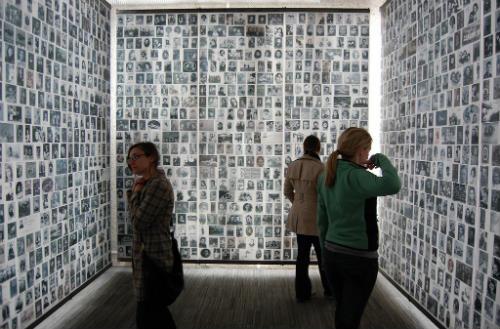
Inaugurated in 2005, it is located where the Memorial to the Unknown Jewish Martyr used to stand. The memorial serves as a bridge between the men and women who lived through the Holocaust and those who did not directly suffer from it or do not know it through their parents.
Address: 17 rue Geoffroy Asnier, 75004. Metro line 1, station Saint-Paul or line 7, station Point Marie.
Fort Mont-Valérien
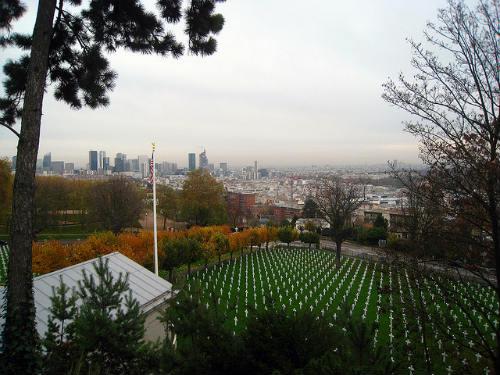
Located in the city of Suresnes (right next to Paris, to the northwest), the site encompasses a fort, the Memorial to Fighting France, and cemeteries (of civilians and American soldiers).
Address: Avenue du Professeur Léon Bernard, 92150 Suresnes
May 8 in the streets of Paris
Throughout Paris, we can see plaques honoring the heroes of World War II and their deeds. These plaques began to be installed as early as late 1944 when Paris was liberated from Nazi domination.
Click here to download the list of commemorative plaques and their respective addresses in Paris.
Commemorative plaques
After World War II, between 1945 and 1948, several Parisian stations and streets were renamed to honor the Allies, members of the Resistance, and important battles. Some examples:
- On line 1: the station "Marbeuf - Rond-point des Champs-Élysées" was renamed "Franklin D. Roosevelt" (in honor of the U.S. president who died in 1945);
- On line 2: the station "Aubervilliers - Boulevard de la Villette" was renamed "Stalingrad" (in honor of the Battle of Stalingrad, 1942-1943);
- On line 5: the station "Lancry" was renamed "Jacques Bonsergent" (a member of the Resistance executed in 1940);
- On line 6: the station "Grenelle" was renamed "Bir-Hakeim" (in honor of the Battle of Bir Hakeim, 1942);
- As of April 22, 2013, the square in front of Hôtel de Ville, the Paris City Hall, was renamed "L'Esplanade de la Libération" (The Esplanade of Liberation, in honor of the liberation of Paris from the Nazis).